
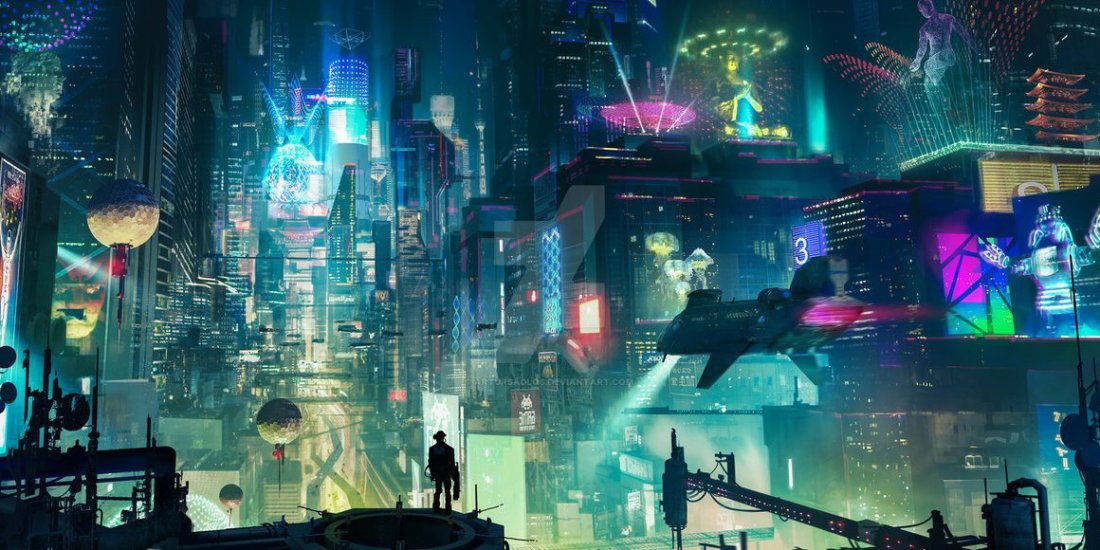
This is the future we got so “wake the fuck up samurai”.
So this is the future you got.
Cyberpunk. Not Star Trek or Fallout. You got cyberpunk. I’m not talking about the capital “c” series of RPGs created by Mike Pondsmith either, I’m referring to the genre of sci-fi which emerged in the late ’70s and early ’80s which speculated rather correctly that the growth of corporate power and increasing indifference to it would lead to a dystopia where we’re so wired to our machines that we find it unable to perceive the truth of our scary reality. “High tech, low life” is the cyberpunk maxim and boy-oh-boy are we there. The smartphone is far more sophisticated a technology than either Gibson or Dick could’ve predicted. It’s not just a super computer in our pocket, it’s an integral body part, a brain outside a brain if you will. Even Major Motoko Kusanagi of Ghost in the Shell would be jealous of the cyberbrains we walk around with everyday. Who needs to build an artificial brain, when every thought we have is stored in a computer stuffed comfortably in our front pockets. Flying cars, replicants, and various other ideas of cyberpunk have yet to come to pass, but in many ways they feel more like unnecessary add-ons as we’ve already got the basic elements. Corporate and state actors know more about us than our own friends and family, proxy conflicts between shadowy factions are a daily routine, and human beings increasingly interact more with computerized consoles than their flesh-and-blood kith and kin. How could this have happened?
What should’ve been a bleak warning of hard-industrial climate killing disaster, was instead sold as sleek-and-shiny progress. The People’s Republic of China’s march away from Maoist communism to a fascistic state capitalism was sold to the West as a march unto progress. Old China, without consideration of the pros and cons of ancient tradition, was quite literally washed away by cities built overnight with amenities that even outclassed its competitors including maglev train lines, state of the art crime preventative surveillance systems, and shopping meccas with every conceivable product you could imagine. So what if millennia old minority cultures like Tibetans, Mongols, and Uyghurs were swept away, this was true progress from a country which had experienced the chaos of the cultural revolution and the backyard smelting days of the Great Leap Forward.
Across the Pacific Ocean, the United States is having its own issues. Political confidence is sadly at an all-time low. The Republicans and Democrats, despite their vicious partisanship, are still seen by many people as two sides of an awful coin. A coin which invaded Iraq out of pure greed. A coin which has been unable to bridge the inequalities both economic and social. A coin which offers vague promises of a better future, despite being trapped in the same old loop of circus-style election cycles which are more about media bombast than trying to solve the ills of a suffering nation. But wherever there’s a roadblock for some, a lane opens for others. Corporations are the beneficiaries of this loss of confidence. Now based on social media soundbites, one might assume that anti-corporate sentiment is at an all-time high. But your Bernie Sanders/Alexandria Ocasio-Cortez style paragons of a more equitable order are few-and-far between, and their followers while zealous occasionally, sway more to corporate influence than they would care to admit. “There’s no ethical consumption under capitalism.” It’s an oft-trotted out maxim in this day-and-age. It’s hard to tell whether it’s a genuine statement of fact or an excuse for complacency. Perhaps both. It’s frustration and resignation mixed in a big bowl salad bowl of “fuck it this is the world I’ve been given”. But no matter our frustration, our loyalties to corporations are far better cemented than that of political parties or even nation-states. We lap up streaming services, online shopping services, food delivery services, and so many other… well, “services”. All of which are run by companies which are usually subsidiaries to even larger companies which are often owned by a few canny and extremely ruthless investors. Jeff Bezos may not dive into a pool of money everyday while telling the WaPo to retract an article which displeases him, but he does exercise such a great amount of sway on the global market that he single-handedly might as well be his own economy. Jeff Bezos, Elon Musk, Mark Zuckerberg, and many other an exec who calls America home, have become far more influential and emblematic of the future than any plucky young congresswoman or cantankerous old senator.
Many people of my generation feel there is no future. That climate catastrophe will destroy us before it’s too late. Influential people of a generation below mine such as Greta Thunberg and Autumn Peltier, remind me of the messianic prophets of old Israel, albeit citing scientific data as opposed to Jewish religious tradition. I understand their feelings and in a way they’re right, but I also think they are wrong. They assume the plan is that these few corporate villains plan on destroying humanity wholesale, but they’re wrong they merely want to immiserate the majority while the minority get to surround themselves with the pleasures of Eden.
Eco-fascism is a term gaining more and more traction. I can’t assuage as to whether every ecocidal bigwig looks up to Hitler or Mussolini, but they do share with those men a callousness and lack of empathy which certainly predominates the fascist frame of mind. Peter Thiel of Palantir and “gay guy paling around with Trump” fame, has already purchased himself a New Zealand hideaway, having estimated that the climate crisis will kill much of mankind and that this Oceanic island might be one of the few places which will manage to survive. Why does he believe this? I’m not certain. Maybe he’s done the scientific research. Maybe he believes in the resilience of the people of this island culture in the face of crisis. Or maybe he just likes Lord of the Rings so much he decided, “this is the land for me”. Whatever his reasonings, I’m certain that Peter Thiel is not a man who intends to die. He is not someone who would simply promote politicians who intend to kill him. If others suffer that’s fine, so long as he and the select few scaly serpents he calls friends live.
The example of Peter Thiel and others like him, leads me to believe that there will be survivors of the ruination about to be heaped upon our earth. But as cyberpunk teaches us, the majority must suffer to enrich this tiny and gluttonous minority. The future is not all of us drowning in a seaside metropolis, but the majority of us drowning while a collection of billionaires live on stilted houses looking down at us like ants. That actually sounds kind of like something from a dark and far more twisted version of The Jetsons now that I think about it.
You would think there would be some kind of awakening to this insidious plot to kill the majority of humanity, but it feels as if we the lump refuse that make up the majority of humankind will go out with a whimper rather than a bang. Mass mobilization to battle corporate control whether through the courts of law or in a worst case scenario, through actual combat, is few and far between. We march, we sing, we protest, but things rarely get done. We post our black square or our fancy hashtag and we sit back down in a cafe taking selfies because “we’re too busy”. We can’t give up our lives, even if the corporations have already deemed them worthless. If this doesn’t scream cyberpunk, I don’t know what does. The existential ennui of this genre and the feeling of isolation it inspires, are rooted largely in an acceptance of the status quo. Yes there’s a tinge of rebelliousness which puts the “punk” in cyberpunk, but it’s an individualistic rebellion largely. It’s one of person vs. system, that usually results in a pyrrhic victory over the system. Maybe you’ve escaped the Matrix but the vast majority haven’t and probably won’t. And maybe they like the Matrix?
Cypher, played by the brilliant Joe Pantoliano (also great in The Sopranos as Ralph Cifaretto), I think represents majority opinion in the cyberpunk scenario. Sure we’ll be a complacent cog in a machine which sees us as ultimately nothing, but at least it won’t be a grim life of fighting. A continual and perhaps eternal struggle against a force greater than ourselves. A war not against man but a system, is something which to many seems wearying and daunting. Systems are tougher to beat than human beings. While humans create systems, they take on lives of their own and can live well-past those who created them. Not a single person alive today is responsible for the creation of the racial caste system which is prevalent in American society, but its still upheld by many different people who have replaced the old cogs and overseers of the machine. Systems are in a way progenitors to artificial intelligence (AI). They exist solely for the usage of human beings and never for themselves. But they persist past our individual lifespans and find new users to keep them going through the allure of power as promised by them. Certainly when you’re about to become the victim of ecocide, holding Cypher’s mentality seems less of a burden, than that of the resistor.
I don’t think we should give up even if we’re now immersed in the dystopia. It’s too easy to do that. That mentality only leads us to more misery. Why push the button which launches the nuclear arsenal of a nation, just because some dipshit general with a hunger for destroying the other side tells you too. It just doesn’t make any goddamn sense to commit suicide because someone else wants you to even if it goes against your own wishes. I don’t know what the solution is, but I think those of us who believe in a more ethical future need to live by a new motto. This motto is a twist on that of Johnny Silverhand, a character played by Keanu Reeves in the upcoming video game Cyberpunk 2077.
“Wake the fuck up samurai, we’ve got a system to burn.”
Categories: Uncategorized

 Tyler Knoll, Creative
Recent Comments