
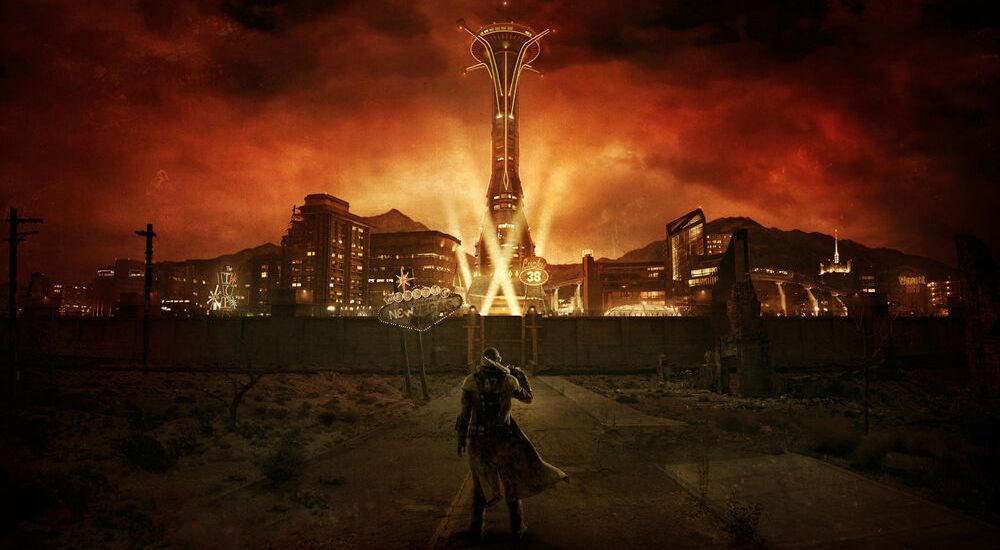
The year is 2281. Its been well over two-hundred years since civilization committed suicide in the Great War of 2077, the ultimate culmination of the years of tension between the communist and capitalist worlds. What’s the use of calling it WWIII when the level of destruction caused by it was so life-altering that it makes the first two global conflicts look like a pissing match in comparison. The environment has been irrevocably changed by the high concentrations of radiation emitted by the blasts. Plant life is lucky if its been mutated as most of it has burnt to a crisp by the atomic fires. Animals have been mutated into either gigantic monstrosities or twisted facsimiles of their former selves. And don’t get me started on what’s happened to the human race! Never mind that the human body has been twisted into the form of the ghoul or super-mutant, the worst urges of humanity have come out through the persistent violence and prejudices which haunted mankind before it had the brilliant idea to nuke itself. But who am I kidding, you know how the rest of this story goes. War… war never changes. Yadda yadda yadda, time for some lone wanderer to venture out from the Vaults to save humanity from itself? Hero saves the day, civilization manages to eeke out some standard of living, and you become a post-apocalyptic messiah, one-half Mad Max. and the other half Jesus Christ.
And then along came Obsidian Entertainment to shake up that paradigm, by keeping the old that worked and adding the new which would lead to the creation of the greatest Fallout game in the franchise’s history.
Fallout has always been a political game franchise, even if it was hard to tell through some of its later installments (I’m looking at you Bethesda). The first two games, take heavy inspiration from the culture of 1950s America, complete with the persistence of big band music into the 21st Century along with an overdose of jingoism and anti-communist rhetoric in the collective consciousness of the nation. These attitudes along with dwindling resources, lead to a conventional war between China and the United States, which eventually metastasizes into nuclear annihilation. Fallout, despite the persistence of dark humor throughout the game, has a keen understanding of the dangers of those Cold War attitudes and correctly diagnoses how it easily could have led to a horrifying end if less cautious individuals had been at the helm. The Atomic Age while a time of scientific progress, was also a time of wanton carelessness in regard to the dangers of nuclear technology. Had the culture and science not advanced into the 21st Century with significant changes, maybe we’d all be gathered around a flaming trash-barrel dying of radiation sickness ourselves. But humanity’s better angels persevered (fingers-crosses they stay that way). Fallout, despite being a post-apocalyptic game, has always spent more time analyzing the pre-apocalyptic world, compared to similar franchises such as Wasteland, Metro, or Rage. While that has led to the creation of a fascinating lore and a retro-futuristic aesthetic which adds to the satirical and musical elements, it comes at the expense of really analyzing what kind of world comes out of a nuclear war.
The main series of Fallout games from the days of the Interplay isometric RPGs to the modern action-oriented games under Bethesda, have almost always focused on a lone wanderer of some kind, usually from a Vault, who follows the traditional hero’s journey of discovering the wasteland beyond and eventually saving it from a greater evil which threatens the existence of its denizens. While in the first two games this was novelty and fun, it got tired by the third installment, even with the changes in gameplay which made the franchise more accessible. The games spent more time satirizing and criticizing the pre-war world, than the one which has come after. The villains of the games, whether they be the creepy Master or the neo-McCarthyite Dick Richardson, usually had terrible enough plans, that we felt compelled to stop them even if they had a rationale which didn’t entirely come from a place of malice.
So when it came time for a spinoff set in the wastes of post-apocalyptic Nevada, what a treat it was that what was supposed to be a sideshow, became the premier example of what Fallout can be if handled properly.
Bethesda, which by all intensive purposes rigged the project to fail, had unintentionally picked the perfect people to work on New Vegas in the form of the original Black Isle devs. While they adapted to the gameplay style of Bethesda RPGs, they decided to return to the Southwestern setting of the first two games, instead of the Bethesda’s romps through previously unexplored East Coast locales. Familiar factions from the first two games returned: The New California Republic, the Brotherhood of Steel, the Great Khans. Would this just be Fallout 3 with a West Coast reskin? Thankfully, not at all.
What New Vegas did that was really different and defining, was that it explored the politics of the post-apocalypse. While the other games all paid lip-service to the idea of rebuilding civilization and the conflicts that arise in the process of doing so, Obsidian put together a story where it had actually been realized. Instead of a Vault dweller emerging from your cave to save the ignorant locals, in a Joseph Campbell approved fashion, you are an ordinary wastelander. A “hapless fink” as Benny might say, in the old-school film noir tradition you’re a fall-guy. Caught between a far greater conflict over the rights to a priceless source of energy for the Mojave, the Hoover Dam, you go from being on a mission of vengeance to becoming a critical player in a war for control of the Mojave Wasteland and its crown jewel, New Vegas. While a myriad of unique factions with their own motivations and plotlines exist in the game, there are three who are of the most consequence in the story, as they will wind up controlling the Mojave should you choose to help them.
The first faction is familiar to players of the original isometric games, the New California Republic. A federal republic modelled after the ideals of the pre-war USA, the NCR in many ways supersedes the country which it models itself after. The NCR is one of the few genuine believers in liberty and equality among the citizens of the wastes. With legal protections for human and mutant citizens alike, the NCR tries to bring a semblance of order and safety to people who have spent most of their lives being the victims of raiders, slavers, and other ne’er-do-wells. The NCR’s elite rangers, in the tradition of the heroic lawmen of the Old West, hunt down bandits and slavers, bringing them to justice and trying to provide aid to the hardscrabble settlers of the Wasteland. The NCR is one of the few civilizations in the Fallout-world which has managed to actually provide some return in the standard-of-living to the people of the wasteland. However, this doesn’t mean the NCR is a utopia. When the NCR started out under its first president, Tandi, its mission was far more noble and clear. Tandi created the NCR to expand the protections of the booming town of Shady Sands to her fellow wastelanders in the New California region. This led to a democratically-elected federation of states to form. The mutual protection and aid offered by the NCR, was understandably very attractive in opposition to the brutal frontier-living which characterized most of the post-war United States. But as the country grew, so too did powerful interests within it. Agricultural “Brahmin Barons” increasingly bought up land for their private enterprises, what formerly had been an economy based on mutual aid, was now becoming one modelled more on the capitalistic one of old. Political influence could now be bought, and the Congress of New California started to become much more like the Congress of the United States with all its faults. To add onto that as the NCR grew in military prowess, so too did its ambitions. Much like the policy of “Manifest Destiny” in the USA, the NCR felt a duty to civilize the wasteland. As it marches east towards the Mojave Wasteland it would try to incorporate tribal communities either peacefully or through force into its structure of taxation and laws. The NCR by launching its campaign to claim the Mojave would also create conflicts with larger factions who could actually challenge their might including Caesar’s Legion and the Brotherhood of Steel. This has led to a seeming “endless war” in the Mojave, which has weakened the economy, but persisted due to the beliefs of warhawk politicians and generals that the land can be tamed (where have I heard this story before???). The NCR in many ways serves as an analogy for the United States during the early 2000s, a country which while incredibly strong both militarily and economically, was losing its way in a campaign of endless wars to supposedly make the world a safer place. The NCR while arguably more understandable and urgent in its motivations, struggles with many issues which plague the USA to this day. But much like the US, the NCR serves as a slightly less shitty option, because the competition… well let’s just say they don’t even live by the illusion of decency.
Caesar’s Legion is essentially what would happen if you let the kid who always shares Roman memes, actually live out his fantasy of governance with no restraints. So in a sense I guess you could say he’s kind of like Mussolini in that way, albeit much more effective and with far less incompetence in military matters. Caesar’s “Roman Empire” much like Mussolini’s is also a crude imitation of the original, as one of your companions Arcade Gannon notes, Caesar picks and chooses what he likes from Ancient Rome to suit his narrative best. The former Follower of the Apocalypse turned slave army master, claims much like the Emperors of Rome to be the Son of Mars. He uses a bastardized form of the Latin language to create a new culture within the myriad of tribes he has assimilated and eliminated by force. Creating an army with such a strict discipline that it would make Hitler’s stormtroopers blush, Caesar’s sole concern is martial prowess, to the point he prefers his soldiers using melee weapons to guns so that they will be stronger in their will. Medicines that have any kind of anesthetic properties are avoided, as Caesar wants his soldiers to be able to ignore pain so they can evolve into hardier humans. Caesar’s built his reputation off the conquest of tribes or “Gauls” as he “affectionately” refers to them. But he’s grown bored with conquering the barbarians east of the Colorado River and now looks for a “Carthage” by which he can stake his true status as a ruler worthy of the Romans he idolizes. The NCR is that Carthage, and much like the Punic state of antiquity, the NCR are a capable foe who have not been as easy for the Legion to dislodge. The Legion is a totalitarian slave-based society, governed by the whims of a self-styled Roman impostor, so why would people go along with it. Well Obsidian tries its damndest to make a compelling case for supporters of the Legion (even if many people, myself included, rejected it at its face). Caesar’s Legion, like many a roving army of pillagers and murders which has come before it whether it be Mongols or Turks understands the basic principles of appealing to the pragmatists of the world. They allow for ease of trade within their territories, the roads within Caesar’s realm being some of the safest in the wastes and the cheapest to do business. Despite having engaged in the genocide and assimilation of multiple tribal communities, Caesar’s Legion is respected more by tribals than the NCR. The “civilization” offered by the NCR is much more difficult for the tribal communities of the wasteland to adapt to, and while Caesar does destroy the individual cultural aspects of the tribal communities he takes over, many of the values of his Legion line up with already existing values within the Wasteland’s tribes. The Legion also has its own crude and twisted beliefs in justice as well, holding a disdain for bribery, trickery, corruption, and decadence, preferring straightforward dealings and open displays of power. You might think this is Obsidian somehow lionizing a totalitarian regime, but rather its them demonstrating they understand the basic character principle that even a villain is the hero of his own story. Caesar’s Legion’s atrocities are on full display in New Vegas, but there’ a raison d’etre behind them, twisted and cruel as it is.
The third and final faction is the Free Economic Zone of New Vegas, which sounds like the name of an ancap’s microstate project and in many ways is under the leadership of its Chief Executive, Robert Edwin House. A pre-war billionaire and scientist, modelled after Howard Hughes, Mr. House realized the world was headed for nuclear Armageddon before the bombs dropped. Always one step ahead, House used his vast fortune to create a missile defense system which would protect New Vegas from nuclear strikes, along with an army of Securitrons and a life-support system which would allow him to live well into his 200s. Mr. House succeeded at his goals, New Vegas compared to many other cities, survived relatively unscathed and Mr. House upon being reawoken from a state of suspended animation, quickly got back to business running New Vegas as his own personal fiefdom and contending with the dangers of this new world. Mr. House is one of the game’s more prescient characters, even if you dislike his own motives, you can’t deny that he recognizes what’s going on better than anyone. Having seen the mistakes that the old world made, he doesn’t want to repeat them again. In the NCR and Caesar’s Legion, he correctly identifies them as imitations of Old World civilizations with all the same faults, and believes them incapable of amounting to anything that would progress the state of humanity. Mr. House believes himself to be the only person capable of advancing humanity and wants New Vegas to be a beacon of light amid the darkness of the wastes. With plans for a future restoration of the surrounding area and even eventual travel to pace to find a new home for humanity far from the destroyed Earth, Mr. House is as ambitious as ever. While Mr. House proclaims altruism, he ultimately thinks for himself and it shows in how he governs. Mr. House is best described as a “liberal autocrat”, a term which on its face sounds like an oxymoron, but in truth has been demonstrated throughout history. A liberal autocracy is quite simply a system whereby one person holds all the power and rules according to a nominally liberal ideology, and by liberal I mean small “l”. Mr. House explains it perfectly with this quote:
“I have no interest in abusing others, just as I have no interest in legislating or otherwise dictating what people do in their private time. Nor have I any interest in being worshipped as some kind of machine god messiah. I am impervious to such corrupting ambitions. But autocracy? Firm control in the hands of a technological and economic visionary? Yes, that Vegas shall have.“
Mr. House unlike Caesar has no interest in legislating the day-to-day economic and social interactions between people. The only thing feared by House is a threat to his own power and control, in which he does compare to Caesar. Liberal autocracies have existed in history before, the best example I can think of being Singapore. This might sound at first jarring to some, as Singapore is well known for cruel and draconian punishments of drug offenders, and issuing fines to people who chew gum and spit in public. While Mr. House certainly has no qualms with drug offenses, spitting, or any human vices, I imagine much of Singapore would be to his liking. Singapore is essentially a one-party state ruled by the Lee family. They have maintained a liberal market economy which is one of the wealthiest in Asia. The standard of living is high and the citizenry are by-and-large free to do as they please aside from a few select vices as mentioned before and most importantly so long as they don’t try to remove the Lee family from power. The Singaporean approach to dealing with dissidents is also much less obvious and obliquely authoritarian compared to other regimes in the world, which is why it usually flies under the radar of human rights organizations. Singapore is the world’s most successful liberal autocracy, it has the veneer of freedom of speech and a free press, without any real support for either of those values by those in power. Mr. House in that tradition is a dictator, despite any pretenses he holds of being otherwise. While possibly more benevolent or at least less invasive than Caesar, he bears the messianic complex and unquestioning demand for obedience which characterizes such a dictator. However, there’s a quick remedy for this all! Simply by working with a reprogrammed Securitron aptly named Yes Man, you can overthrow Mr. House and make yourself… the liberal autocrat! Yes, the independent option is seen by some players as the “obviously correct” option as it for the most part allows you to keep New Vegas independent from other bodies while also removing the tyranny of Mr. House. But really at the end of the day you’re simply inheriting Mr. House’s position as the autocrat of New Vegas. The diplomacy that will guarantee the city’s fate rets on your shoulders, this is not you being the savior in the Lone Wanderer fashion of previous games, but you being the ruler of the Free Economic Zone of New Vegas. If that feels good to you then go for it, but just note that the idea it is the “correct” decision is not what Obsidian is going for.
The truth is in New Vegas, there are no right decisions. Yes the Karma system exists (and it is definitely way harder to be in the good if you roll with the Legion), but at the end of the day much like in a real war, there are no binary “good guys vs. bad guys”. Instead its a measure of weighing evils and figuring out which one you think will fuck over the Mojave Wasteland the least. The minor factions in game, can be guaranteed their own survival through your decisions or can be brought to ruination should you choose it. Is that right? Again it depends (unless you’re the Fiends, fuck those guys for real). Even the DLCs while dealing with smaller, self-contained stories, in different locales, navigate complex decisions where you must weigh difficult choices. The idea of binary good/bad choices (something Bethesda is unfortunately way too fond of), is too simplistic for something as grim and brutal as the world of Fallout. Obsidian understands that Fallout is a franchise whose ultimate message since the first game has been that war is truly humanity’s greatest folly and that even after a civilization-ending catastrophe, they still continue in roughly the same manner as before. The conflicts of previous and future games in the franchise, however, never allowed the player to make factional choices with true meaning as New Vegas has. This is why the game remains venerated to this day and why fans still dream of a proper sequel developed by Obsidian.
Final Note:
An idea I’ve recently had upon learning of Microsoft’s purchase of Bethesda has been to pitch an idea for my dream sequel to Fallout: New Vegas. I’ll try to have it finished in the following weeks and will post it to my blog. Many great mods have been made already trying to do the same thing including brilliant Fallout: The Frontier and Fallout: New California. I highly recommend looking both up and checking them out, the modders have worked their magic and have done wonders for the community of fans like myself. I also recommend keeping an eye on the Fallout: New Vegas remake mod which is being done through the Creation Engine of Fallout 4. With the design document I’m creating, I’m hoping to try and put together something that will create public attention and further remind Bethesda of the fan desire for a sequel to New Vegas. I’m under no illusion that my idea is likely not to be made into a reality, but if I can raise awareness or in any way get the ball rolling for a sequel to be made to one of my favorite games, I’d appreciate any support. Hell, if you can get my idea out there to J.E. Sawyer, the original New Vegas director, I’d appreciate it a tonne.
Happy trailers partners! And remember
War… war never changes.
Categories: Uncategorized

 Tyler Knoll, Creative
Recent Comments